
Climate Change
Using Ice Cores to Measure Past Climates
The Two Mile Time Machine
Weather stations around the world measure daily temperatures and weather conditions, but to understand whether these temperatures are unusual and significant we also need to know about the Earth's past climate. This helps us understand the influence humans are having on the climate of today.
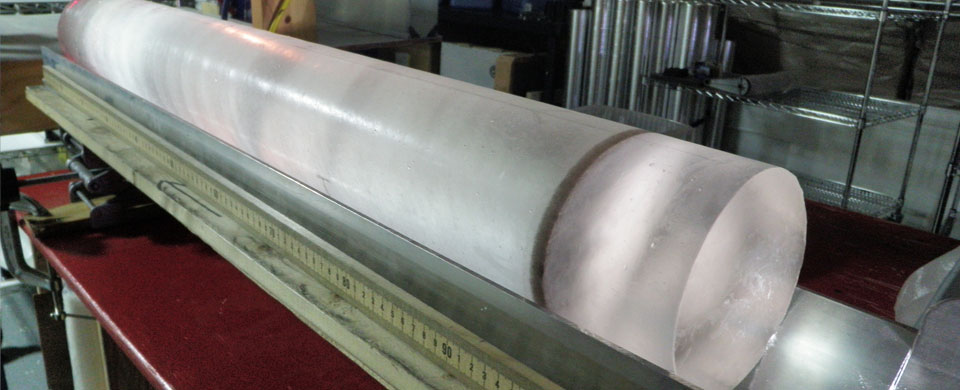
Scientists are drilling ice cores in the Antarctic and analyzing them to find out what the Earth's temperature and carbon dioxide levels were like in the past. Ice and water are made up of oxygen and hydrogen. Scientists study the oxygen atoms in ice cores to reveal past temperatures.
There are 2 common types (isotopes) of oxygen atom, known as 18O and 16O, which have different weights. Ice that contains a high proportion of 16O was formed when the Earth's temperature was low, while ice containing lots of 18O was formed in warmer temperatures. This method is called isotope analysis.
Gases Trapped in the Ice
 One of the main advantages of analyzing ice cores is that they show levels of carbon dioxide in the atmosphere at different points in Earth's history, as well as recording temperature. Many of the other methods of calculating past temperatures don't do this.
Air bubbles remain trapped in the ice. Scientists use these to find out the concentration of greenhouse gases like carbon dioxide and methane. Analysis of ice cores has shown that when carbon dioxide levels are high, so is global temperature.
Finding the age of Ice
An ice core is like a timeline – the newest ice lies closest to the surface while ice that was formed thousands, or even millions, of years ago is deeply buried. Scientists find out the age of the ice by comparing the isotopes in each layer to existing records of the Earth's climate.
To make sure their dating is accurate, they also look at significant features in the ice core. These include layers of dust, or small amounts of the chemical sulphuric acid, which are evidence of big volcanic eruptions. Scientists know the dates of many of these events and so they can use them to check the age of the ice core.
Scientists also know how quickly ice usually forms in particular regions of the world and this helps them work out when each section of an ice core was formed.
Antarctica is thought to have been covered by ice for over 30 million years. So far, scientists have drilled ice cores stretching back 800,000 years, and they are now working to extend their records back to 1.4 million years ago.