
Climate Change
Understanding the Role of Greenhouse Gases
How does Earth maintain a steady temperature?
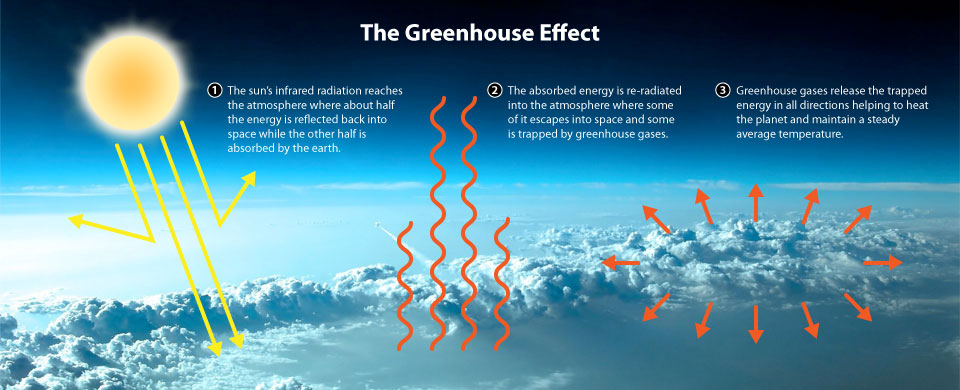
In order to understand why Earth is warming it is necessary to understand the role of the oceans and the atmosphere, the 2 biggest factors that regulate temperature. As the sun's rays reach the atmosphere, a lot of that energy (heat in the form of carbon-dioxide) is absorbed by the oceans thereby bringing down the temperature. The oceans then slowly emit the heat from the sunlight they've absorbed, and increase the temperature of the surrounding atmosphere. The atmosphere further regulates temperature by allowing this heat to radiate into space, countered by greenhouse gases that retain some of that heat. Without greenhouse gases to trap heat Earth's average temperature would be 59 degrees cooler on average. This cycle of cooling and heating is constant, helping maintain a relatively stable temperature all around. This is called the carbon dioxide cycle or, the CO2 cycle for short.
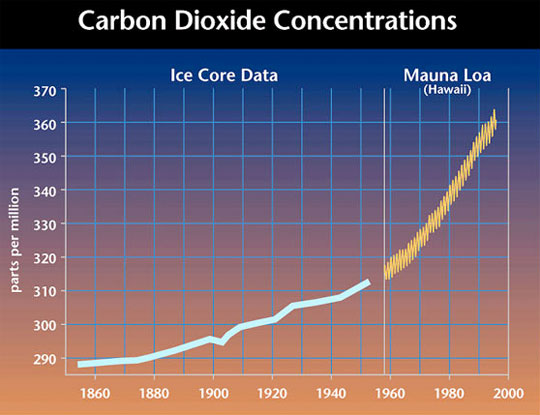
Recently, an increase of greenhouse gases has played havoc with this delicate balance, trapping more heat in the atmosphere and increasing the planet's temperature. Since the industrial revolution heavy accumulations of carbon-dioxide in the atmosphere has resulted in what some scientists regard as an alarming trend. Experts estimate that carbon-dioxide levels now exceed 394 ppm. At the beginning of the industrial revolution, CO2 levels were below 280 ppm and have grown exponentially over the decades. A particular concern is that atmospheric levels of carbon dioxide may be rising faster than at any time in Earth's history, except possibly following rare events like impacts from large extraterrestrial objects. The current levels are estimated to be higher than in the past 600 thousand years and possibly the last 15 million years.