
Climate Change
Glaciers and What They Tell Us About Global Warming
Glaciers and Climate Change
Glacial ice can range in age from several hundred to several hundreds of thousands years, making it valuable for climate research. To see a long-term climate record, an ice core is drilled and extracted from the glacier. Ice cores have been taken from around the world, including Peru, Canada, Greenland, Antarctica, Europe, and Asia. These cores are continuous records providing scientists with information regarding past climate. Scientists analyze various components of cores, particularly trapped air bubbles, which reveal past atmospheric composition, temperature variations, and types of vegetation. Glaciers literally preserve bits of atmosphere from thousands of years ago in these tiny air bubbles. This is how scientists know that there have been several Ice Ages. Past eras can be reconstructed, showing how and why climate changed, and how it might change in the future.
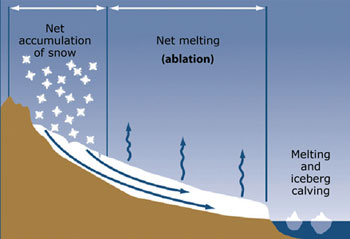 Scientists are also finding that glaciers reveal clues about global warming. How much does our atmosphere naturally warm up between Ice Ages? How does human activity affect climate? Because glaciers are so sensitive to temperature fluctuations accompanying climate change, direct glacier observation may help answer these questions. Since the early twentieth century, with few exceptions, glaciers around the world have been retreating at unprecedented rates. Some scientists attribute this massive glacial retreat to the Industrial Revolution, which began around 1760. In fact, some ice caps, glaciers and even an ice shelf have disappeared altogether in this century. Many more are retreating so rapidly that they may vanish within a matter of decades. Scientists are discovering that production of electricity, along with coal and petroleum use in industry, affects our environment in ways we did not understand before. Within the past 200 years or so, human activity has increased the amount of carbon dioxide and other greenhouse gases released into the atmosphere.