
Climate Change
Greenhouse Gases and the Greenhouse Effect
Greenhouse Gases
Greenhouse gases let shortwave solar radiation through the atmosphere, but impede the escape of long-wave radiation from the Earth's surface. This process is fundamental to the greenhouse effect — a process by which thermal radiation from a planet's surface is absorbed by greenhouse gases and re-radiated in all directions. Since part of this re-radiation is sent back towards the lower atmosphere, the result is an elevation of the average surface temperature. This process keeps the planet at a livable temperature. Without a suitably balanced mixture of greenhouse gases in the atmosphere, the planet's average surface temperature would be somewhere between -9 and -34 degrees Fahrenheit.
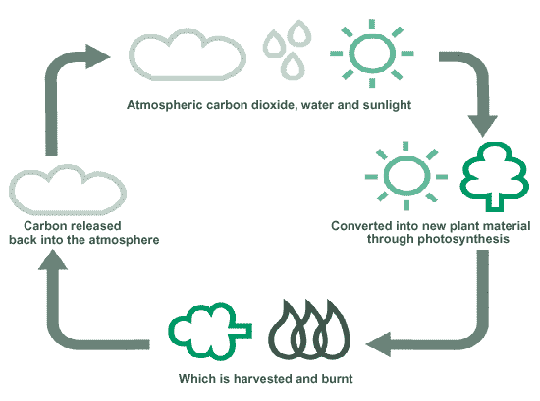
The primary greenhouse gases in the Earth's atmosphere are water vapor, carbon dioxide, methane, nitrous oxide, and ozone. Levels of several of these important greenhouse gases have increased by about 25 percent since large-scale industrialization began around 150 years ago. During the past 20 years, about three-quarters of human-made carbon dioxide emissions were from burning fossil fuels.
While natural processes, such as plant photosynthesis, can absorb some of the net 6.1 billion metric tons of human produced (anthropogenic) carbon dioxide emissions each year, an estimated 3.2 billion additional metric tons is added to the atmosphere annually. The Earth's positive imbalance between emissions and absorption results in the continuing growth in greenhouse gases in the atmosphere.
The U.S. produces about 25 percent of global carbon dioxide emissions from burning fossil fuels; primarily because our economy is the largest in the world and we meet 85 percent of our energy needs through burning fossil fuels. The U.S. is projected to lower its carbon intensity by 25 percent through 2025, and remain below the world average.