Climate Change
The Impact of Global Warming on Artic Communities
The Arctic and Its People: Vulnerable to Change
Scientists have long predicted that human-induced climate change will have its first and most severe impacts in polar regions. The Arctic is more sensitive to climate change than perhaps any other place on Earth, and its unique physical characteristics help explain why the region is so vulnerable. With extremely low temperatures, limited sunlight and precipitation, and a short growing season (averaging only 50 to 100 days), the region has one of the most severe environments on the planet. Arctic sea ice, snow cover, tundra and permafrost are highly susceptible to even subtle variations in sunlight, surface temperature, and precipitation. Ecosystems in the Arctic exist in a delicate balance with the region's climate, and thus are more sensitive to change than temperate or tropical ecosystems.
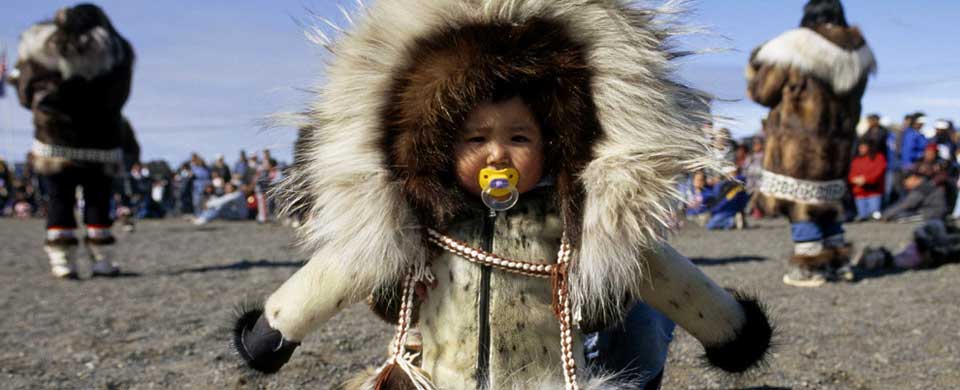
Human communities also survive in a delicate balance with the Arctic climate, and are therefore equally sensitive to change. Hundreds and even thousands of years ago, Arctic populations adapted to gradual or even rapid environmental change by settling amid favorable climate conditions and along the paths of animal migration. Today, though, Arctic people cannot adapt or relocate as easily, because most now live in permanent communities. People's dependence on the natural world, combined with the Arctic's natural vulnerability, magnify the potential effects of global climate change on Arctic inhabitants.
Indigenous communities, whose knowledge of the land, sea, and ice dates back thousands of years, are already reporting signs which may be due to significant climatic change. Inuit hunters have noticed discoloration and thinning of sea ice, changes in open water areas within the ice, and the presence of animals not previously found in their region. Sea ice is now unstable where hunters previously knew it to be safe. The Gwich'in Athabascan people in Arctic Village, Alaska have witnessed dramatic changes in weather, hydrology, vegetation, and animal distribution patterns, changes that have occurred during residents' lifetimes. Their observations both precede and corroborate scientific predictions for the region.
Other signs of change: Annual temperatures have increased many times the global rate, about 2.7 degrees F over recent decades, over parts of Canada's western Arctic, Alaska, and eastern Siberia. In central Alaska, temperatures have increased by 7.2 degrees F over the past 30 years. During the summer of 1995, ice cellars in Alaska were too warm to keep foods frozen.
Finally, climate change is likely to affect overall weather patterns in the Arctic, generating more frequent Arctic storms and other extreme weather events. Weather is an all-important factor of Arctic life; In Canada's Inuktituk language, for example, there are 25 ways to express types of snow. Floods, storms, and extreme cold greatly affect human capacities to hunt. Since animals such as caribou and salmon are generally available only during short periods in summer and early autumn, more frequent extreme weather events could disrupt seasonal animal harvests.
Warmer temperatures and melting sea ice are also expected to increase sea levels along the Arctic coastal region. Rising seas and coastal erosion directly threaten Tuktoyaktuk, a Dene and Inuit community located at the edge of the Arctic Ocean. Ice which once protected the coast has receded out to sea. Extensive erosion washed away the school, and has forced the village to relocate many other structures.