
Climate Change
The Impact of Global Warming on Coral Reefs
Coral Reefs
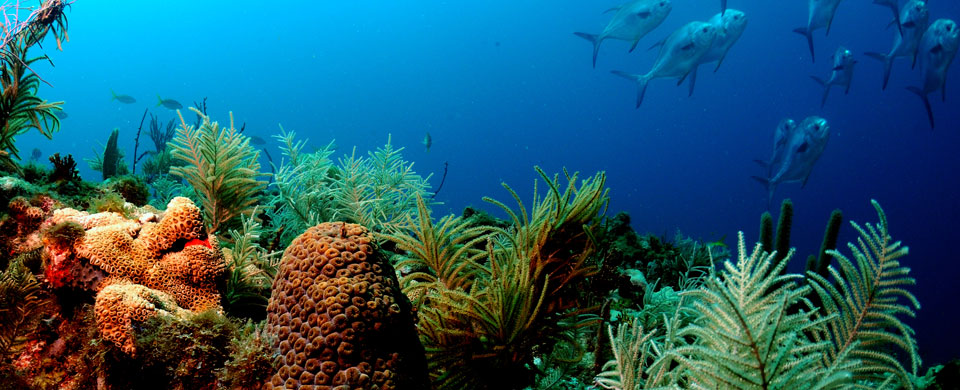
The spectacular and delicate coral reefs of Florida, Hawaii and Puerto Rico are ecological gems and important economic resources. Often called "rainforests of the sea" for their rich biodiversity, the coral on which these diverse ecosystems are based are actually living organisms themselves. They form when polyps--the living portion of stony corals--extract calcium from seawater and combine it with carbon dioxide to construct the elaborate limestone skeletons that form the reef.
Between just Key Biscayne and Dry Tortugas, the Florida Keys contain about 6,000 coral reefs. This reef system--third largest in the world--contains more than 100 species of soft and stony corals and hundreds of fish species, from tiny sergeant majors to giant barracudas.
Threats from Global Warming
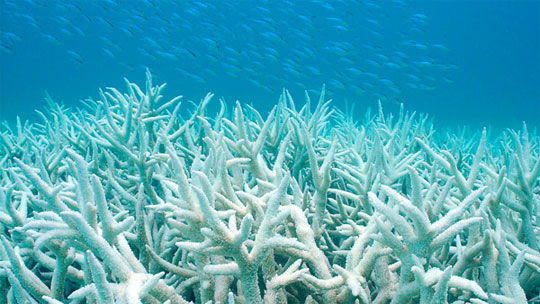 Higher sea temperatures from global warming have already caused major coral bleaching events. Bleaching occurs when corals respond to the stress of warmer temperatures by expelling the colorful algae that live within them. Some coral are able to recover, but too often the coral dies, and the entire ecosystem for which it forms the base, virtually disappears.
Longer-lasting and more extensive bleaching events are already on the rise, with further increases expected in the decades ahead as ocean temperatures continue to rise. Warmer waters are also expected to increase the incidence of other coral diseases such as black band disease, white band disease, white plague, and white pox, all of which can lead to mass mortality of coral, and subsequently the entire ecosystem it supports.
Ocean acidification--which occurs when oceans absorb carbon dioxide from the atmosphere--is also a threat to coral. As the oceans become more acidic, the corals' ability to form skeletons through calcification is inhibited, causing their growth to slow. A doubling of atmospheric carbon dioxide will reduce calcification in some corals by as much as 50 percent.
Sea level rise caused by melting sea ice and thermal expansion of the oceans could also cause problems for some reefs by making them too deep to receive adequate sunlight, another factor important for survival.